
From Ambition to Delivery: The Next Phase of Climate Capital in Australia

The Climate Investor Forum is the annual pulse check for climate capital in Australia.
This year felt like the right balance of optimism and pragmatism. The hype has faded and so has the Trump-induced despair. The focus now is action and execution.
The enormous opportunity remains.
Nearly every major climate investor in the country was in one room representing hundreds of billions of investment potential. Start-up positioning is evolving. Corporate engagement is real, just quieter. And the policy backdrop is arguably stronger than at any point in the last decade.
AI was certainly a topic, but it wasn’t discussed in every session.
A few takeaways from Melbourne:
Key Learnings & Takeaways
1. Corporate climate action is still strong, just quieter
The shift is from bold net zero pledges to pragmatic execution. Corporates are still moving, but with less noise and more focus on economics, resilience and shareholder scrutiny.
The key gap remains structured corporate offtakes and meaningful commercial engagement with early stage climate companies.
There is intent. But there is still friction at the interface between startups and large buyers.
This is where partnership-led models matter. Investors who can help de-risk adoption through introductions, pilots and structured procurement pathways create disproportionate value. Capital alone is rarely enough.
2. Founders are leading with economics, not emissions
This is a noticeable shift from even two years ago.
The strongest startups are no longer leading with climate impact. They are leading with unit economics, cost parity or clear pathways to parity, productivity gains and security of supply. The climate outcome sits alongside.
That framing matters in this capital environment.
Climate solutions that:
• Reduce input costs
• Improve asset utilisation
• Enhance resilience
• Unlock new revenue
are gaining traction faster than those selling impact.
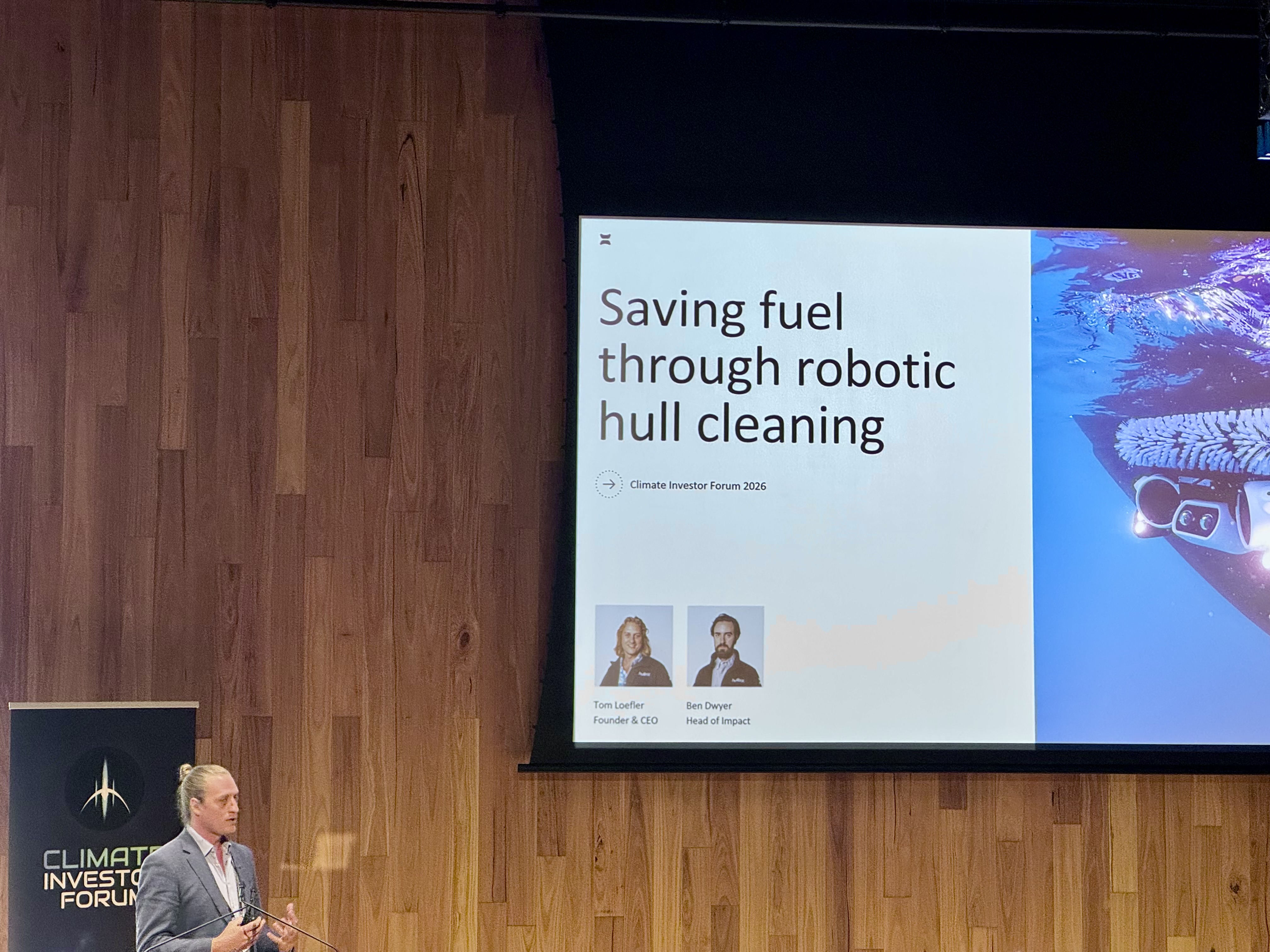
Great to see Hullbot, one of CTP’s portfolio companies, onstage. A great example of leading with savings and a reminder that climate innovation in Australia is not just about gigawatt scale infrastructure. It is about solving practical decarbonisation bottlenecks with software, robotics and automation.
3. Adaptation remains dramatically underinvested
Mitigation still dominates venture flows, but adaptation came up repeatedly.
BNEF estimates approximately US$0.5 trillion per year will be required globally, and that is just for first order effects. It does not account for second order impacts across infrastructure, food systems and insurance markets.
We are still early in the adaptation capital stack and business models remain a key area of focus for investors.
It feels like the start of the inflection point for adaptation investment (in part driven by the undeniable impacts accelerating).
4. Liquid fuels are the next frontier and a major industrial opportunity for investors and Australia
One point that came up multiple times across the conference was, liquid fuels account for roughly one third of Australian emissions and they now exceed emissions from electricity generation.
Aviation and maritime face real electrification constraints due to energy density requirements.
Decarbonising liquid fuels is therefore central to Australia’s emissions reduction pathway. But it is also a major industrial opportunity.
On the SAF panel, (moderated by Fraser Thompson (Cyan), with Harry Jobberns (Qantas), Prue Newall (IFM Investors), and Jesse Scott (GrainCorp) and myself) we discussed three overlapping dynamics of the opportunity.

First, decarbonisation. Hard to abate sectors such as aviation and maritime require drop-in fuels. There are no real alternatives at scale.
Second, energy security. Australia imports more than 90percent of aviation fuel and holds roughly 20 days of reserves. That is a strategic vulnerability.
Third, commercial upside. CEFC estimates a roughly $36billion domestic opportunity by 2050. Globally, SAF alone could represent a$500 billion annual market.
Australia is well positioned. We have feedstock potential, land availability, renewable energy resources and proximity to Asia.
But the building blocks need acceleration:
- Early stage capital to support tech advancement to bring down costs
- Feedstock innovation
- Clear demand signals and policy support
- Demonstration that we can build the infrastructure for proven SAF technologies
A market is forming. But speed matters. If we move too slowly, we risk doing we Australia often does, exporting raw feedstock and importing a finished product at 10X the cost.
5. Government capital is active and well stocked
Federal institutions including CEFC, NRF and ARENA are increasing activity and have been topped up with substantial dry powder.
In a global context of policy volatility, Australia is increasingly seen as a relative bright spot for:
• Policy stability
• Co-investment support
• Project level financing
Expect deployment to increase.
For founders and investors alike, alignment with government capital pools is a structural advantage.
Overall mood
Less hype.
More realism.
Better companies.
More aligned capital across different stages but the missing middle remains a challenge.
The transition is underway.
If the last five years were about ambition and capital formation, the next five are about delivery. Those who position themselves now will benefit the most.
That is a good place to be.
Reach out if you are keen to learn more about Climate Tech Partners and how we are investing and engaging across these areas.
Latest articles
.jpg)
Low-carbon liquid fuels (LCLFs) are the only near-term decarbonisation path for sectors that can’t be easily electrified including aviation...
.png)
.png)