
Navigating Electricity Price Volatility in the Transition to Clean Power

At Climate Tech Partners, we believe that the future of some key climate technologies will be shaped as much by the cost and availability of green electricity as by advances in hardware and project design. This is why we think deeply about electricity price dynamics, engaging directly with experts in the field and our Corporate Partners: to understand how and when prices may shift as it is critical for scaling the next generation of power dependent climate solutions.
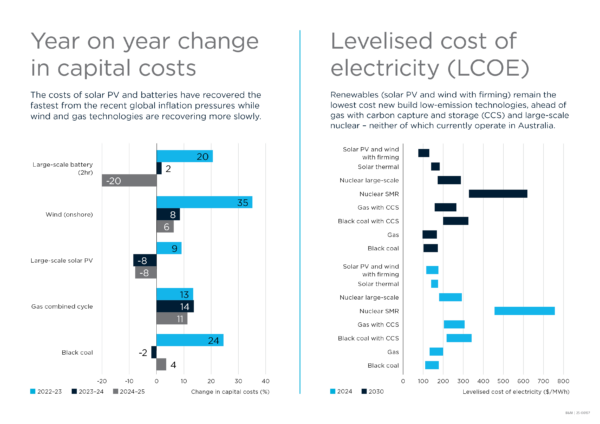
Our recent Electricity Price Workshop reinforced just how complex and consequential this landscape has become. The transition to a renewables-dominated grid is not just about reducing emissions but is key to bringing costs down as firmed renewables are the cheapest new build generation. The transition will be driven by many factors including policy frameworks and capital requirements that will determine which technologies thrive.
Source: CSIRO 2024-25 GenCost Report
Power Prices: more volatility and greater probability of increases than decreases in the short to medium term but government policy will play a huge (uncertain) role
Insights from the workshop showed that while the costs of new technologies including solar panels, batteries, and financing are continuing to fall (even after huge decade long declines), additional costs from new transmission lines, increasing demand from data centres and general electrification trends as well as coal fired power plant retirements are likely to more than offset these benefits. Wholesale electricity prices are therefore still more likely to trend upward or, depending on policy dynamics, at least stay around current levels in the medium term.
In addition, most participants agreed that volatility is likely to be a defining feature of the transition given the increase in renewable share. The large battery deployments, as well as home battery incentives, will mitigate some of the volatility, but it is still too early to be clear by how much. Extreme peaks (typically from multiday renewable “droughts”) are unlikely to be matched by long duration storage.
For climate technologies this volatility is not just noise, it is a key driver for electricity prices. Price spikes, even if rare, have a material impact on overall price. As an example, the NEM released for Q2 2025 that wholesale power averaged A$140/MWh; most hours were around $103/MWh, but a few extreme spikes added $37/MWh to the quarter’s price. On 12 June, the NEM’s daily average price hit $1,610/MWh (all-time high); together with 11 & 26 June, those three days added $32/MWh, over 85% of the quarter’s spike component.
Key electricity price drivers we are watching
- Government policy as a decisive lever: Policy interventions such as the Australian Capacity Investment Scheme, underwriting for transmission projects, and mechanisms to manage coal exits will be pivotal. Achieving ambitious renewable targets require enabling policies that provide long-term certainty and bankable conditions for developers.
- Coal retirement profile as a swing factor: The pace and sequencing of coal exits remain one of the largest variables shaping medium-term pricing. Accelerated closures could trigger near-term scarcity and price spikes, while delays may lock in excess capacity and unnecessary costs. Unplanned outages further amplify volatility.
- Transmission as a bottleneck: Grid expansion will be decisive in unlocking the value of low-cost renewable resources, yet costs and timing remain highly uncertain. Delays to major projects such as HumeLink, Marinus Link, and VNI West are already constraining investment decisions and cost overruns risks are significant. Until transmission catches up, congestion and curtailment risks will weigh heavily on project development.
- Demand growth and flexibility: Electrification (EVs, heating, industrial loads) and the rapid increase in energy demand for data centres is likely to drive demand growth, but the scale and timing are uncertain. Demand-side innovation, such as virtual PPAs, demand response, and flexible contracting, will partially act as a supply-side balance in smoothing volatility.
- Role of firming capacity as a key driver: Batteries, long-duration storage, and flexible generation will play a critical role in shaping future price outcomes by balancing variability and providing reliability when renewable supply is low.
- Bidding behaviour and market dynamics: Strategic bidding by market participants, especially under tight supply, can artificially create scarcity and drive price spikes. Battery bidding strategies will also have an impact.
- Behind-the-meter, while attractive, remains challenging: Large-scale behind-the-meter deployments (particularly in first-of-a-kind (FOAK) projects) introduce additional upfront capex and technical complexity, which can undermine their feasibility and near-term adoption.
Workshop discussions highlighted that while access to low-cost electricity is essential, project developments depend on a broader set of factors. For projects such as Power-to-Liquids (PtL) or hydrogen, viability is also shaped by factors such as CAPEX requirements, operational efficiencies, and regulatory support on both the supply and demand sides. Recognising both dimensions is critical to understanding the full range of risks and opportunities facing new projects.
Our perspective: why this matters for climate tech
We see an emerging opportunity for climate technologies that can operate profitably in environments of cheap, green, and at times volatile electricity. From power-to-liquids to electrified industrial processes, competitiveness will hinge on the ability to align operations with shifting price patterns, to manage risk through contracting innovation, and to design projects with both capex discipline and operational flexibility.
When it comes to deploying new technologies, power prices are only part of the equation. Equally critical are the upfront capex requirements and other cost factors that shape whether a project can get off the ground. Driving these barriers down is just as important as improving efficiency if we want to see real adoption at scale.
The energy transition is no longer just about building cleaner generation. it is about navigating a more volatile and uncertain pricing environment. For climate technologies, power costs will be both a constraint and an opportunity. Companies that can align with price signals, manage risk creatively, and adapt to shifting policy and market conditions will be those that scale successfully. The workshop reinforced that volatility is not a temporary feature of the transition, but a structural reality we must plan for. Preparing for this now will be decisive in determining which technologies thrive.
About Climate Tech Partners
Climate Tech Partners is a venture capital firm dedicated to investing in globally scalable technology solutions across Energy & Power, Transport & Logistics, and Industrials & Resources, in collaboration with leading corporate partners to support and accelerate growth.
Contact: info@climatetech.partners
Latest articles
.jpg)
Low-carbon liquid fuels (LCLFs) are the only near-term decarbonisation path for sectors that can’t be easily electrified including aviation...
.png)
.png)