
Investment Note: Renewable Metals
.jpg)
An advanced recycling solution addressing key battery supply-chain gaps in the clean energy transition.
Opportunity: Battery recycling needs a better answer
The clean energy transition is driving significant competition for critical minerals, making domestic supply and material security a strategic priority. Recycling offers a pathway to localise supply chains, reduce import dependence, and enable more resilient battery production, particularly if it can be delivered at lower cost. Yet the dominant recycling technology, acid-based hydrometallurgy, is capital-intensive, waste-heavy and economically challenging especially for lithium iron phosphate (LFP) batteries. LFPs now represent ~40% of global EV battery capacity and are growing rapidly. The market’s core need is for a solution that can process all major battery lithium chemistries efficiently, cleanly and at scale.
In addition, recycled battery materials can reduce lifecycle emissions from cell manufacturing by ~30–50% compared to virgin mining. Regulation is also emerging as a supportive tailwind, with Europe mandating lithium recovery rates of 50% by 2027, rising to 80% by 2031, and other regions likely to follow. Lithium-ion battery recycling is a large and rapidly scaling market, expected to grow by approximately 20x between 2030 and 2050, driven by exponential EV and battery storage development (IEA), Renewable Metals is positioned as one of the very few facilities capable of processing it domestically, economically and cleanly.
Solution: Alkali-based recycling, elegantly repurposed
The core approach behind Renewable Metals is simple and technically compelling: apply a proven process from base-metals mining to the challenge of battery recycling, delivering a step-change in performance and economics.
Unlike conventional acid-based plants, Renewable Metals’ alkali-based process can recycle all major lithium battery chemistries on a single processing line, and the company has ambitions to process whole battery packs and damaged units directly, avoiding a disassembly step that many recyclers currently require. This capability is not just operationally advantageous, it is a key driver of cost efficiency, reducing the need for pre-processing and enabling abroader, lower-cost feedstock mix.
The process achieves over ~95% recovery of metals through a closed-loop system and avoids the step of shredding batteries to black mass where up to 15% of materials can get lost. In addition, Renewable Metals’ process eliminates sodium sulfate waste (a low-value by-product that adds disposal costs).
At scale, the process is expected to deliver up to 50% lower costs than acid-based alternatives. Moreover, its modular, prefabricated design enables profitability at smaller throughputs, better aligned with today’s fragmented and supply-constrained feedstock environment. It can also be retrofitted into existing recycling plants, a timely advantage as underutilised acid-based plants continue to accumulate globally. The combination of lower capex and opex makes Renewable Metals’ technology particularly attractive.
Strong corporate validation
CTP also leveraged its network to engage with relevant corporates and industry experts in Australia and internationally, helping inform its broader assessment of the opportunity and market landscape.
- A CTP corporate partner identified a direct commercial angle: the ability to safely process damaged battery packs without complex disassembly could materially reduce total loss rates and improve residual asset values, while also creating a natural feedstock sourcing channel.
- Other CTP corporate partners mentioned having, or having had to deal with, defective ordiscarded batteries that could be, or have been, relevant to Renewable Metals.
- Ampyr Energy, targeting 6,000 MWh of operational battery storage across Australia by2030, has publicly announced a Battery Recycling Framework MOU with Renewable Metals, describing it as a clear and deliberate move toward supporting acircular pathway for battery materials, covering both interim volumes andend-of-life recycling.
Importantly, these relationships strengthen Renewable Metals' future feedstock position. As battery storage assets mature and EV volumes grow, operators increasingly have to deal with end-of-life and damaged or defective batteries. The capability for Renewable Metals to process whole packs across all chemistries enables a streamlined one-stop-shop disposal solutionfor users.
Team and execution
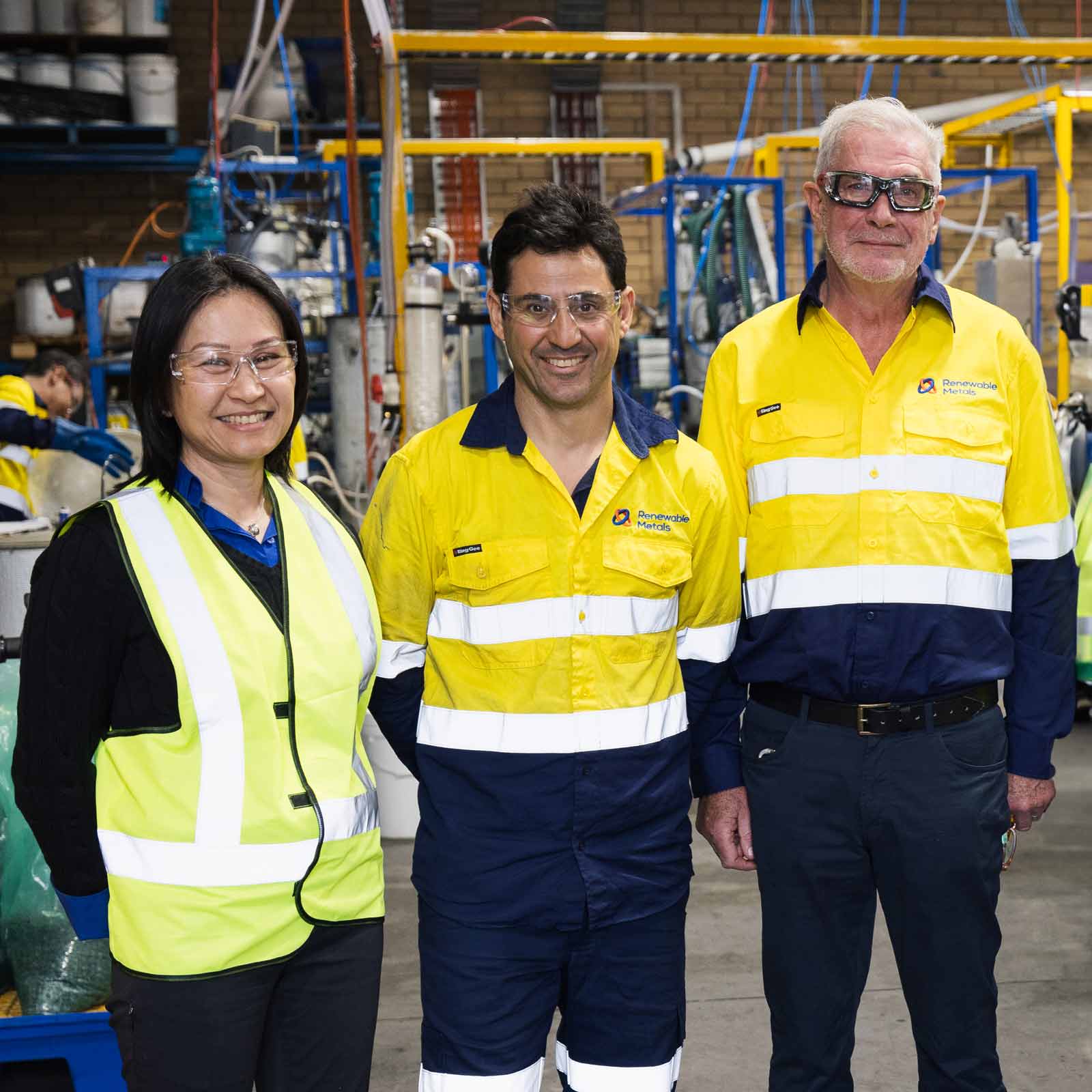
Renewable Metals’ strength is equally reflected in the calibre of its team. CEO Luan Atkinson brings strong analytical rigour, shapedby experience across top-tier consulting and fund management. Co-founder and CTO Mark Urbani contributes more than two decades of expertise in hydrometallurgy, the core discipline underpinning the company’s process.
The executive team is reinforced by Chair Peter Beaven, former CFO of BHP, adding deep operational and capital markets experience plus extensive networks. Collectively, the team has raised over A$32 million to deliver a commissioning-stage demonstration plant in Kewdale, Western Australia.
Why CTP invested and what comes next
Our investment decision was driven by Renewable Metal’s unique process. It’s ability to process mixed chemistries, including LFP, alongside whole and damaged battery packs on a single processing line addresses a growing challenge for recyclers as battery streams become more diverse and operationally complex. Equally important, the compelling economics and technology retrofit potential creates multiple pathways for adoption. With the process now validated at pilot scale and a demonstration plant in commissioning, CTP has the strong convictionthat Renewable Metals has established the right technical and commercial foundation to scale with credibility.
Post-investment, we are working with our corporate partner network tosupport Renewable Metals’ commercial pipeline and accelerate adoption as the company scales from its demonstration plant to its planned commercial Hunter Valley facility.
We are proud to back Luan, Mark and the team at this important stage of growth.
Latest articles
.jpg)
Low-carbon liquid fuels (LCLFs) are the only near-term decarbonisation path for sectors that can’t be easily electrified including aviation...
.png)
.png)